6
min read
Loyalty Programs in 2026: Redefining Customer Loyalty Through Data & AI-Powered Personalisation


As 2025 comes to a close, everyone here at TRIFFT is still celebrating lots of big wins in what has been an amazing year. From great new clients in exciting industries to successful launches of our new AI-powered tools to the growth of our team and more, it has been a whirlwind of hard work and fantastic rewards.
But the calendar tells us that it will soon be time to turn the page and that’s why we’re shifting our focus to 2026 and the trends & topics that will define the loyalty industry. If the pace and scale of the changes that we’ve seen in the last twelve months are an indication of things to come, we definitely have a lot to look forward to.
So join us for this look at our predictions about what everyone will be talking about in the world of loyalty programs in 2026.
Loyalty programs have long relied on the idea of segments, groups of customers put together on the basis of a relevant, defining shared characteristic. Segments can be as general and high level as gender, income group, etc. or as granular as mothers with young children who mostly buy online during sales in the winter — there are no rules on how wide or narrow a segment can be.
Still, customers in those segments always get basically the same offers, making them both tailored and generic at the same time.
The days of doing this are now numbered thanks to segments of one. In this strategy, every single loyalty member is treated as a distinct market of one individual. This is easily done with today’s technical capabilities and opens a new world of outreach opportunities:
Segments of one are a shift from demographic approximation (putting many customers together because of a common trait) to behavioural precision (personalised messaging at scale based on collected data).
Three forces are converging to make 2026 the year of the Segment of One:
The "Segment of One" changes the mechanics of loyalty programs in three ways:
Traditional Loyalty — Static catalog (everyone sees the same range of options, which is designed to appeal to everyone, making it less compelling).
Segment of One — Dynamic marketplace (rewards curating based on individual hobbies & interests).
Traditional Loyalty — Batch-and-blast emails. Minimal personalisation and it shows.
Segment of One — Triggered outreach and “reminders” based on real-time location or activity.
Traditional Loyalty — Gold/Silver/Bronze based on spend. Maybe a little too “traditional”?
Segment of One — Invisible, fluid tiers based on engagement and potential value.
The bar has been raised in lots of areas of digital marketing but, as we mentioned with the “Netflix Effect,” personalised communications is at the top of the list. If your loyalty program is still treating customers like part of a demographic instead of an individual with his or her own unique history of purchases and interactions, you aren't building loyalty—you're just renting their attention until someone else gets to know them better.
Making the shift toward this mentality needs to be at the top of your 2026 to-do list.
“Last purchase date” used to be the main metric when trying to identify at-risk customers, but it’s being replaced with something much more useful and accurate—”propensity to churn.”
Odds are that 2026 will mark the official end of "one-size-fits-all" loyalty programs. The days of blasting the same "Double Points Weekend" email to your entire database will look as outdated as a loyalty card full of smudged stamps.
That’s because the future of loyalty isn't about more rewards—it's about smarter interactions. The two engines driving this revolution are Propensity Modeling and the Next Best Action (NBA) framework. Together, they are transforming and upgrading loyalty outreach into a predictive, profit-generating machine.
Here is why these two technologies will be the defining trends of 2026.
In 2026, brands won't have to wait for customers to act because they will anticipate the move before it happens. Propensity modeling uses historical data and machine learning to calculate the precise likelihood (propensity) of a customer taking any of a range of specific actions.
These predictions will operate on dynamic, real-time scores:
The 2026 Difference: Until now, this data was reviewed periodically and the review itself took time. In 2026, these scores will update in real-time, allowing brands to create personalised offers and treat each customer as a segment of one (wait, that sounds familiar…).
This means having the ability to act quickly to both take advantage of small windows of opportunity and reactivate certain customers before it’s too late. While “propensity” is never a guarantee of anything, it gives the best possible chance to take proactive and preventative measures that keep customer conversations going.
If propensity modeling is the radar, NBA is the pilot. It takes the probability score for certain outcomes and selects the best move to make for that specific individual right now.
The NBA engine moves loyalty beyond "If This, Then That" rules into complex decision-making. It weighs business value against customer value to answer a crucial question—What is the most profitable way to make this customer happy right now?
Look at these common scenarios and compare the conventional way of responding with what is possible with Propensity and Next Best Action insights:
The Conventional Way — The customer stops visiting. 60 days later, an automated "We Miss You" email sends a generic 20% off coupon. Doesn’t this already seem like an ancient way of dealing with the problem?
Propensity + NBA — The model detects a drop in app usage frequency (Churn Propensity spikes) and triggers a push notification before they leave, offering a non-monetary reward (e.g., "Free Lounge Access" or "Early Access to Sale") to re-engage them without devaluing the brand.
The Conventional Way — A customer buys a TV and later receives the same "10% off accessories" email as everyone else.
Propensity + NBA — The model sees they bought a TV but have a low propensity to buy cables (they likely already have them) and skips the discount. Instead, it sends a "How-to guide" on calibrating the TV picture settings to build emotional loyalty and trust.
The biggest trend for 2026 is the shift toward emotional loyalty. It’s the only kind of customer loyalty that lasts in today’s marketplace.
While transactional loyalty may be easier to achieve, it is fleeting and temporary. Customers with transactional loyalty are gone the moment a better offer comes along or a brand drifts off their radar.
Propensity modeling and NBA allow a brand to prove it "knows" the customer and act accordingly. When, for example, an airline creates a Next Best Action that automatically rebooks a tight connection before the customer lands, that earns more loyalty than any amount of free miles ever could. Propensity modeling can stop a problem before it starts and get better results than a too-late “We miss you!” email ever could.
These are the kinds of experiences that tie customers to a brand based on something more than transactional benefits.
The internet’s unspoken rule has long been "We track you, and you get to use our site for free." In 2026, this rule will be packed up and sent to some museum, where it belongs.
The most significant shift in loyalty programs won't be about points or tiers—it will be about consent. As third-party cookies vanish due to reforms introduced by online giants and privacy regulations tighten globally, brands are losing their ability to follow the footsteps left behind by visitors to their sites.
The solution? Zero-Party Data—and a transparent new implied contract called the Privacy Value Exchange. In 2026, the brands that win won't be the ones with the most data, they will be the ones with the most permission and loyalty programs are the perfect platform for this exchange, turning privacy from a legal hurdle into a relationship builder.
Unlike First-Party Data (which you passively infer from clicks and purchases), Zero-Party Data is information a customer intentionally and proactively shares with you. It is high-quality, high-intent data that no algorithm can guess.
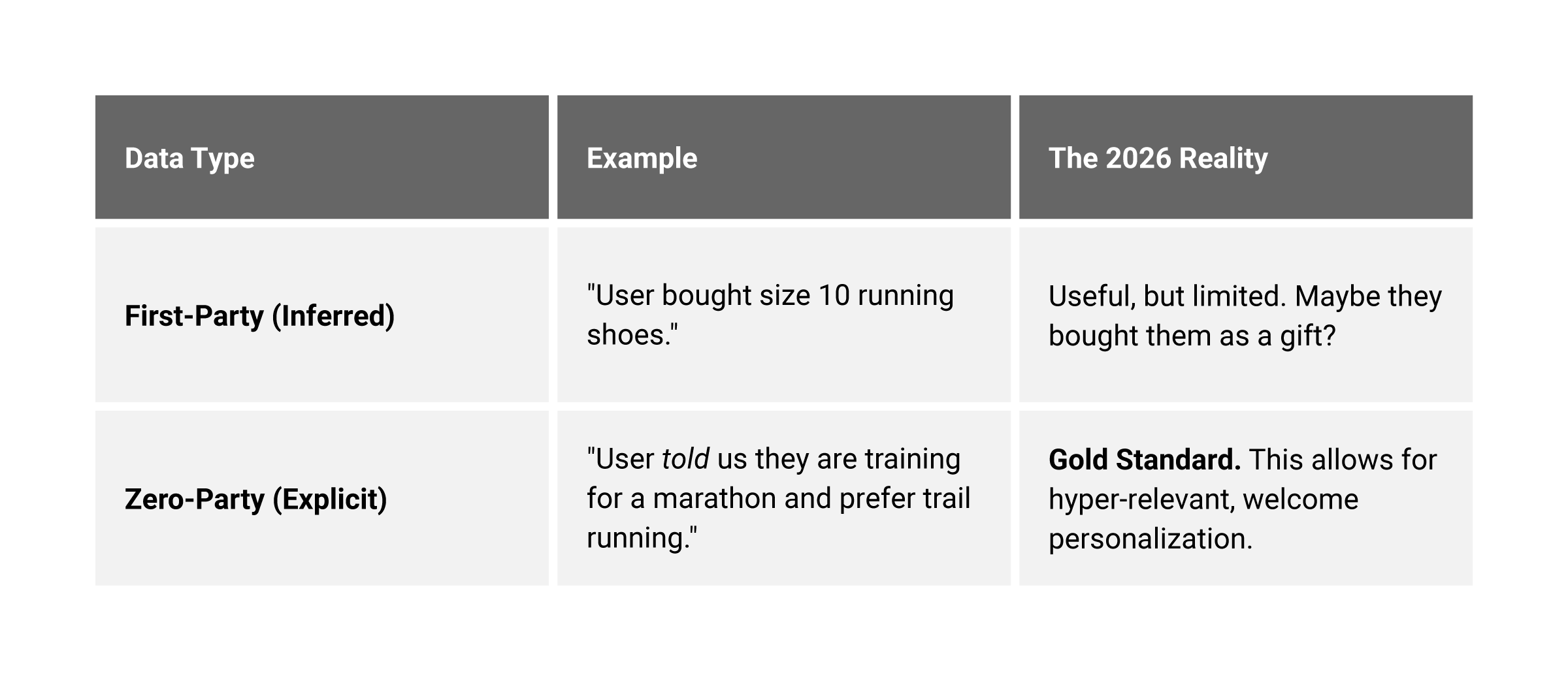
In 2026, customer data will be treated as a currency. Customers are increasingly aware of their data's value and will no longer give it away for free. The bad news is that they will expect a direct "payment" in the form of better experiences, but the good news is that it’s a trade they’re willing to make—if you can show that it’s worth it.
Think of the Privacy Value Exchange as a kind of understanding between a customer and a brand, a transparent deal where the customer agrees to share their personal data (intentions, preferences, contact info) in direct exchange for a tangible benefit (better service, discounts, exclusivity, or convenience).
This flips the old dynamic of third-party cookies and treats data as a currency that the customer owns and chooses to spend.
Here is how this exchange works:
Instead of passive tracking, the customer proactively provides Zero-Party Data:
To earn that data, the brand must offer something of equal or greater value:
Leaving third-party cookies behind and instead embracing this new model represents a shift from passive surveillance (tracking clicks) to active collaboration (asking for preferences). This means informed consent from customers and direct participation in crafting their content experiences.
Look at the advantages this new reality offers for better customer conversations:
Third Party Cookies (Surveillance)
Privacy Value Exchange (Consent)
As third-party cookies vanish completely, loyalty programs become the primary vehicle for data collection. But customers in 2026 are savvy and they know their data has value. Give it to them.
It’s simply a fact that many consumers have reached loyalty fatigue. Their phones are full of apps they used once and forgot about. They’ve lost count of the clubs they’ve joined just to get a discount at checkout and then forgot about those too. They’re no longer intrigued by the prospect of reaching anyone’s “Gold Tier,” no matter what the rewards might be. Many are numb to constant offers to join this or earn points for that. But this is only a problem for brands that are stuck in the old ways of loyalty—for everyone else, it’s a massive opportunity.
That’s because in 2026, the brands that cut through the noise won't just offer rewards. They will offer entertainment.
Gamification is at the core of modern loyalty and will reach new heights in the coming year as part of the larger shift from transactional loyalty ("Buy this, get points") to emotional loyalty ("Play this, feel good").
Here are some ways that Gamification will further evolve in 2026 and engage loyalty program members in new ways.
In 2026, rewarding customers only for spending money is the bare minimum. The new standard is rewarding engagement.
Brands will use gamification to incentivise behaviours that don't immediately generate revenue but build long-term value:
Loyalty has traditionally been a solo sport. In 2026, it becomes multiplayer.
Brands will introduce Squad Goals, where friends pool their points or efforts to unlock shared rewards.
The evolution of gamification in loyalty programs is being driven by the rise of new technical possibilities. The bar is high and rising — “Spin to Win” can still be effective, but who knows for how much longer.
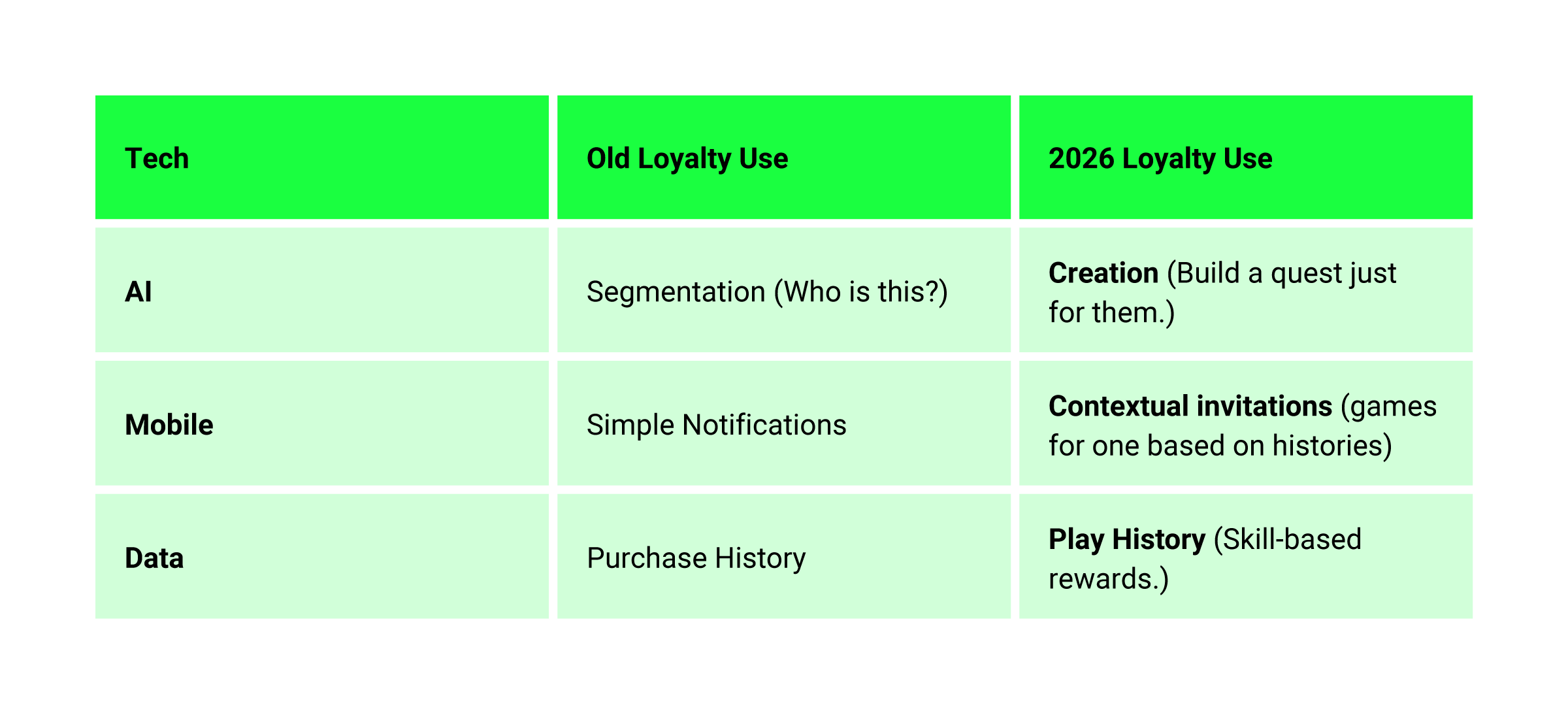
Generative AI and Spatial Computing are transforming gamification from a static layer on top of your app into a dynamic engine that drives it. In 2026, we will see more movement away from obvious gamification (where you know you are playing a game) to gamification woven into the experience (where interactions with the brand feel like an adventure).
To win in 2026, you don't just need a points engine. You need a Game Engine.
The best loyalty programs in 2026 will be the ones customers hardly notice.
The goal now is not to feel like a “program” at all, and instead make loyalty outreach a seamless extension of interactions with a brand. Loyalty will mean the right offer before you search for it, respecting privacy without being asked, making the act of shopping feel a little more like play and much more.
In 2026, technology will allow brands to treat every customer with the care and attention needed to make them feel like an entire experience has been crafted just for them—because it has.
Learn more about how TRIFFT can help you achieve your goals in 2026 and beyond with a personal introduction everything an effective loyalty program can do by scheduling a demo today.
Book a 15-minute chat with our experts to explore possibilities, discuss your needs, and discover tailored solutions.
Book
.jpg)